Showing posts with label discussion. Show all posts

Wednesday, October 9, 2019

Digital Assessment Resources

As I spend a lot of time looking at resources for teachers and practices related to assessment, I have uncovered a few quality resources that not everyone may be using.  This post will discuss digital assessment resources which can be incorporated into your class.

Project-Based Assessment Resources -

Continuous Diagnostic / Check-Ins Based on Standards - 
Questioning and Discussion Resources - 
These resources all are either free or have at least enough free access to make them useful.  Check them out and let me know what you think!

Wednesday, April 24, 2019

What's going on?!

It's the end of April and testing season has begun. So "What's going on?!" seemed like a fitting introduction to this post. Up is down. Down is up. Will we ever make it to June? No worries, we think that EVERY year and we ALWAYS make it!


What's going on in this picture is actually a discussion technique for students posted each week by the New York Times. This is what their website says:

Students

1. After looking closely at the image above (or at the full-size image), think about these three questions:

• What is going on in this picture?

• What do you see that makes you say that?

• What more can you find?

2. Next, join the conversation by clicking on the comment button and posting in the box that opens on the right. (Students 13 and older are invited to comment, although teachers of younger students are welcome to post what their students have to say.)

3. After you have posted, try reading back to see what others have said, then respond to someone else by posting another comment. Use the “Reply” button or the @ symbol to address that student directly.

Each Monday, our collaborator, Visual Thinking Strategies, will facilitate a discussion from 9 a.m. to 2 p.m. Eastern Time by paraphrasing comments and linking to responses to help students’ understanding go deeper. You might use their responses as models for your own.

4. On Thursday afternoons, we will reveal at the bottom of this post more information about the photo. How does reading the caption and learning its back story help you see the image differently?

This is great for any ELA or history teacher at ANY level to get students talking, making inferences, and talking about their thinking. Science teachers that observation is an important part of the scientific method, so it could be used to teach them to observe the world around them in a systematic way.  You could pose the visible thinking strategies questions to the students. This closely mirrors what we know about teaching students to practice close reading.

Some ideas for its use include:

  • Using it as a Monday Google Classroom discussion prompt
  • Giving the students the picture and letting them annotate around it
  • Having them think-pair-share in partners about what it reminds them of in order to make connections
My favorite picture is this one - What's going on?!

How will you use this resource in your classroom?

Friday, February 15, 2019

Critical thinking

When searching for a definition of critical thinking that would apply well to a classroom setting and the instructional design of a teacher, I was discovering that the meaning of this term is as diverse as the students in the classroom.  My favorite definition so far is over-simplified - "thinking to produce judgment" - clear, concise, to the point.  But the skill itself is at the highest levels of Webb's DOK - analyzing, synthesizing, supporting a claim.

Image result for webb's dok


Since learning is largely social, one of the best ways to get students to think critically about the judgments that they are making is to hear the alternative judgments that others are making and support the viewpoint with evidence.  Some great discussion techniques for the classroom include:


Sometimes students who are not normally active participants in the in-class discussion can feel more successful with an online discussion, such as in Google Classroom.  Another website I ran across recently which allows students to participate in a discussion, make a claim and support it is Kialo.  According to Common Sense Education's review of the site, "It's a good platform to teach the importance of reasoned, respectful arguments when trying to persuade others."  It can be used to participate in public or private discussions through the teacher platform.  As we help students learn how to build an argument, it can also serve as ideas for good questions to get the students motivated to discuss.  

Students are participating in discussions online through social media, so hopefully as teachers we can use a site like this to guide them to be better 21st century digital citizens.


Wednesday, September 27, 2017

Empowering students

I spent the day with some other WR staff members at the MCL Summit in State College, PA.  As I listened to students and teachers and administrators from other schools talk about what they are doing and how, I thought about the small ways that we are already empowering our students.  Here are some of the great instructional practices that already exist at Warrior Run.


Having students work toward the standard but letting them decide the product.  While students might need to work on their writing skills, they are allowed to do so in different forms, from researching a passion project to blogging about a favorite hobby.  Being engrossed in the topic allows them to feel that there is a purpose to the activity beyond school.  When students make connections to the real world, they stop asking “why do I need to know this?”


Encouraging discussion and debate.  In the information age and an era of fake news, students have to be mediators of their digital diet.  Being able to distinguish fact from opinion and research from rhetoric will help them refine their synthesis skills in order to venture through the current media and political landscape.  As teens struggle to find themselves and define who they are, this can look like challenging a teacher.  While respect is necessary, sometimes students are more of an expert on certain topics, especially as the internet makes it possible to develop skills outside a traditional setting.


Transforming the classroom.  While a teacher with a board at the front of the room with students in rows is the traditional understanding of a classroom, research suggests that today’s learners, who are constantly connected to the world through their phones, need a wide variety of instructional strategies.  Direct instruction has its place, but so do collaborative groups, independent work stations, and other types of blended learning.  In order to optimize these strategies, sometimes a classroom transformation is necessary.  Elementary teachers are the experts of maximizing the classroom space, with different areas of the class for different tasks.  As students grow, the most important aspect is flexibility.  I was recently inspired by a number of ideas (see this, this, and this), but I really enjoyed this website for planning the layout.


Encourage risk-taking and failed attempts.  Just in the same way that parents or teachers model a love of reading to children by demonstrating that they read for their own enjoyment, teachers can model a growth mindset by sharing their stories of risk-taking and failure with their students.  Life is messy and students who realize it won’t be perfect and instead develop resiliency will be more likely to try difficult tasks and succeed.  Knowing that a teacher will be there for them when their plans don’t work out creates the necessary self-esteem (and safety net) to be willing to work through complex tasks.  My favorite example that a teacher created was an #epicfail wall where students shared their funny attempts that failed.


Creating time for reflection.  One of the most important parts of the learning process is reflection.  The feedback supplied by a teacher is so much more meaningful when internalized by a student.  Think of those moments when you couldn’t stop dwelling on an event - it stuck with you, right?  You won’t forget what you learned from that experience.  Allowing an opportunity to review the feedback and discuss it with the teacher will encourage students to reflect, but so will modeling.  A teacher can share how they reflect by talking aloud about their thinking.  When our kids make a mistake, like trying to open their yogurt upside down, my husband will ask, “What did you learn?”  While he’s doing it to lighten the mood and make the kids laugh, they instantly reflect on what went wrong.  Do they learn?  Sometimes.


Many of these ideas are not new to this generation, they are just meaningful experiences that we know develop our students into well-rounded adults.  As you reflect on how to incorporate them into your class, take pride in the fact that I was inspired by seeing the work of Warrior Run teachers.


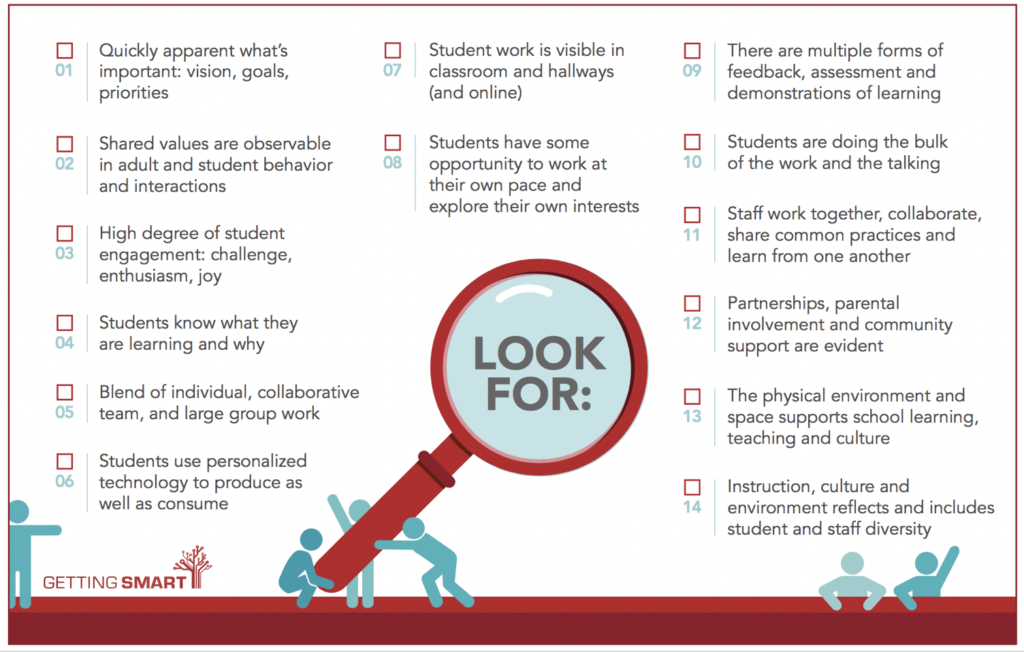
Image from a Getting Smart article on Student-centered learning